Thursday, May 19, 2016

The Work Opportunity Tax Credit (WOTC) - Earn Federal Income Tax Credits for your Company

WOTC is a federal income tax credit available to employers for hiring individuals from certain target groups who have consistently faced significant barriers to employment.
The WOTC tax credit is a one-time tax credit for each new hire – and there is no limit to the number of new hires who can qualify an employer for a tax credit. 
What are the WOTC target groups ?
  • Qualified Veterans 
  • Qualified Disabled Veterans 
  • Qualified Unemployed Veterans 
  • Qualified Designated Community Resident 
  • Qualified Ex-Felons 
  • Qualified Vocational Rehabilitation Recipient (requires release form) 
  • Qualified Supplemental Nutritional Assistance Program (SNAP) (Food Stamps) Recipient 
  • Qualified Supplemental Security Income (SSI) Recipient (requires release form)
  • Qualified Recipients of Temporary Assistance to Needy Families (TANF) 
  • Qualified Summer Youth
The WOTC Program has been reauthorized through December 31, 2019. An employer must obtain certification that an individual is a member of the targeted group, before the employer may claim the credit. An eligible employer must file Form 8850, Pre-Screening Notice and Certification Request for the Work Opportunity Credit, with their respective state workforce agency within 28 days after the eligible worker begins work.
The credit is limited to the amount of the business income tax liability or social security tax owed.
The maximum tax credit ranges from $1,200 to $9,600, depending on the employee hired and the number of hours worked in the first year. Employees must work at least 120 hours in the first year of employment to receive the tax credit.
Relatives or dependents (this includes a spouse), majority owners of the employer, and former employees do not qualify for WOTC.


contact@officetaxservices.com

(858)247-1680


Wednesday, May 18, 2016

Using QuickBooks - Tracking Mileage


Keeping track of mileage helps you get all the reimbursements you're due and it is important because all business-related mileage is tax-deductible. QuickBooks can help you keep records of the miles you drive.
If you want to track mileage on the vehicles you use for your business, create entries for your vehicles in the Vehicle List (List - Customer & Vendor Profile Lists - Vehicle List) first, set up the mileage rate (Company - Enter Vehicle Mileage - Mileage Rates), record mileage driven (Company - Enter Vehicle Mileage) and then, record the vehicle, date, miles driven, odometer settings, and reason for the trip.
Usually with the actual expenses method, you get a higher business vehicle expense deduction. However, note that the IRS limits the amount that you can include as vehicle depreciation, so you may not get the highest deduction with this method.
No matter which method you use, you need to record of your actual business miles, which the Enter Vehicle Mileage command enables you to do. By law, you need a good record of business mileage to legitimately claim the deduction.
When you prepare your taxes you can use one of the reports generated by QuickBooks. (Reports - Jobs, Time & Mileage)
  • Mileage by Vehicle Summary;
  • Mileage by Vehicle Detail;
  • Mileage by Job Summary;
  • Mileage by Job Detail.


contact@officetaxservices.com

(858)247-1680


Tuesday, May 17, 2016

Excise Taxes for a Business

 
Excise taxes are taxes paid when purchases are made on particular items. Excise taxes are often included in the price of the item. You may also pay excise taxes on certain activities, such as highway usage, telephone service or gambling.
Most of the time excise taxes are figured as part of the price of the commodity or service. Unlike sales tax, the excise tax isn’t listed separately. 
Business owners or product or service vendors are responsible for collecting the excise tax and turning it over to the government.
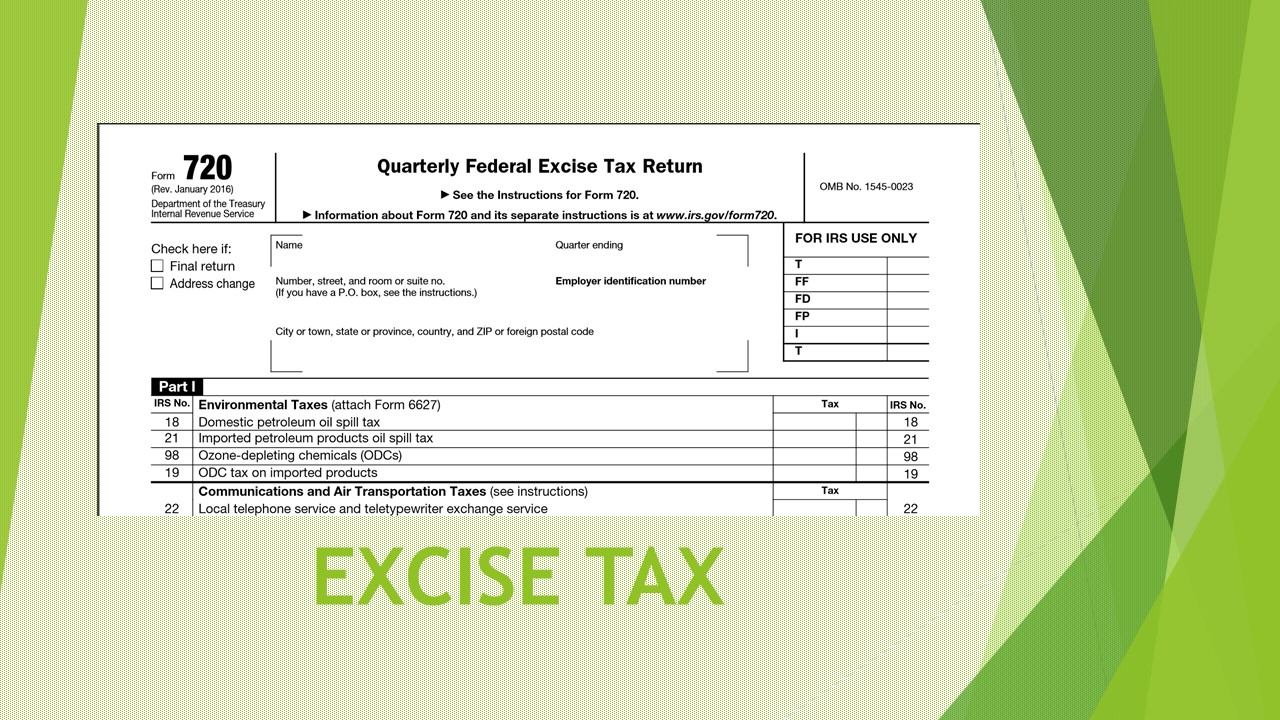
If you run a business that’s required to collect an excise tax, you collect the tax and pay the tax to the government each quarter. You’ll file Form 720, Quarterly Federal Excise Tax Return. Form 720 lists the various types of excise taxes in effect, including the following:
  • Environmental taxes
  • Communications and air transportation taxes
  • Fuel taxes
  • Tax on the first retail sale of heavy trucks, trailers, and tractors
  • Manufacturers' taxes on the sale or use of a variety of different articles
There is a federal excise tax on certain trucks, truck tractors, and buses used on public highways. The tax applies to vehicles having a taxable gross weight of 55,000 pounds or more. Report the tax on Form 2290, Heavy Highway Vehicle Use Tax Return.

If you are in the business of accepting wagers or conducting a wagering pool or lottery, you may be liable for the federal excise tax on wagering. Use Form 730.

For more information on excise taxes, see Publication 510.


contact@officetaxservices.com

(858)247-1680


Using QuickBooks - Price Levels

Price levels allows you set custom pricing for different customers or jobs. When you define price levels and assign them to customers, QuickBooks takes care of adjusting the prices on every invoice you create. You can also apply a price level to specific lines on invoices to mark up or discount individual items. 

Fixed percentage price levels allows you increase or decrease prices of all items for a specific customer or job by a fixed percentage. If you have a fixed set of discounts, you might name the various levels by the percentage, like Discount 20 for example. An alternative is to name them by their purpose, like NewCustomer. That way, it's easy to change the discount amount without changing the price level's name.

To create a price level, make sure the price level preference is turned on. If QuickBooks' Price Level preference is turned off, you won't see the Price  Level Item in the List menu. Check it at Edit - Preferences - Sales & Customers, and then click the Company Preferences tab. Select the Enable Price Levels radio button, and then click OK.


contact@officetaxservices.com

(858)247-1680


Monday, May 16, 2016

Your Self-Employed Tax Obligations

If you are an independent contractor, sole proprietor or a member in a partnership or of an LLC, you are considered self-employed and need to understand your self-employed tax obligations. You're subject to the tax if you were self-employed and your net earnings from that source were $400 or more.
As a self-employed individual, generally you are required to file an annual return and pay estimated tax quarterly.
Self-employed individuals generally must pay self-employment tax (SE tax) as well as income tax. SE tax is a Social Security and Medicare tax primarily for individuals who work for themselves. It is similar to the Social Security and Medicare taxes withheld from the pay of most wage earners. 
You must figure your net profit or net loss from your business to determine if you are subject to self-employment tax. You figure self-employment tax (SE tax) yourself using Schedule SE (Form 1040). A self-employed has to pay 15.3% of his or her self-employment income.
The rate consists of two parts: 12.4% for social security (old-age, survivors, and disability insurance) and 2.9% for Medicare (hospital insurance).
Inactive partners are subject to the self-employment tax.
You can deduct the employer-equivalent portion of your self-employment tax in figuring your adjusted gross income. This deduction only affects your income tax. It does not affect either your net earnings from self-employment or your self-employment tax.


contact@officetaxservices.com

(858)247-1680


Sunday, May 15, 2016

Does a Small Business Need to Pay Estimated Tax?

You generally have to make estimated tax payments if you expect to owe tax of $1,000 or more when you file your return. If you had a tax liability for the prior year, you may have to pay estimated tax for the current year. The IRS rule is that you must pay at least 90% of income taxes (and self-employment taxes) during the year or 100% of income taxes from last year, to avoid fines and penalties.

If you are filing as a sole proprietor, partner, S corporation shareholder and/or a self-employed individual, you should use Form 1040-ES, Estimated Tax for Individuals, to figure and pay your estimated tax.

For estimated tax purposes, the year is divided into four payment periods. Each period has a specific payment due date. If you do not pay enough tax by the due date of each of the payment periods, you may be charged a penalty even if you are due a refund when you file your income tax return.

Remember, because the business owner owes the tax, the owner must pay from his personal account. 


contact@officetaxservices.com

(858)247-1680


Does Small Business Need an EIN Number?

You will need an EIN if you answer "YES" to any of the following questions:
  • Do you have employees?
  • Do you file any of these tax returns: Employment, Excise, Alcohol,Tobacco or Firearms?
  • Do you withhold taxes on income, other than wages, paid to a non-resident alien?
  • Do you have a Keogh plan?
  • Are you involved with any of the following types of organizations?
    • Trusts, except certain grantor-owned revocable trusts, IRAs, Exempt Organization Business Income Tax Returns
    • Estates
    • Real estate mortgage investment conduits
    • Non-profit organizations
    • Farmers' cooperatives
    • Plan administrators
If you need an EIN number, you can apply:
  • Online
  • By Fax
  • By Mail
  • By Telephone - International Applicants
How to apply for an EIN

You can get an EIN immediately by applying online. International applicants must call (267) 941-1099. If you prefer, you can fax a completed Form SS-4 to the service center for your state, and they will respond with a return fax in about one week. If you do not include a return fax number, it will take about two weeks. If you apply by mail, send your completed Form SS-4 (PDF) at least four to five weeks before you need your EIN to file a return or make a deposit.


contact@officetaxservices.com

(858)247-1680